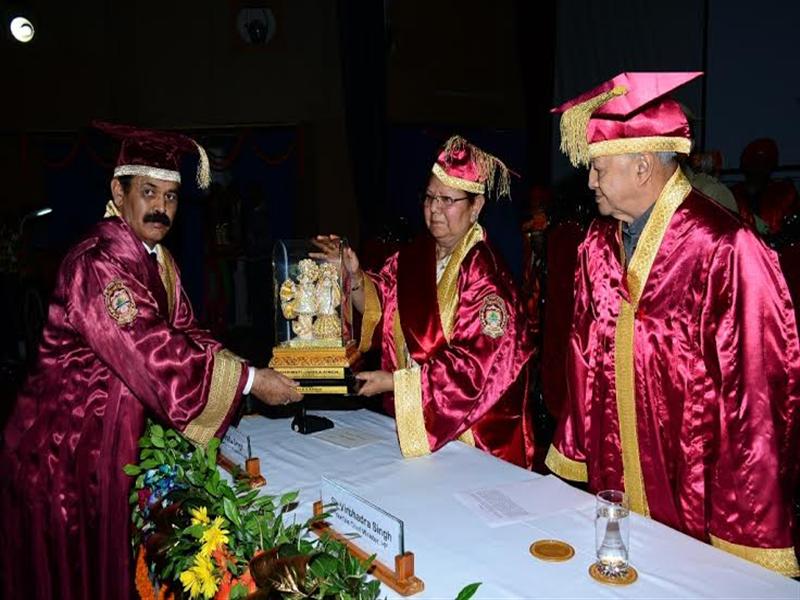
Smt. Urmila Singh, Governor who is also the Chancellor of CSK H.P. Agriculture University, Palampur presided over the 12th Convocation of the University today. Shri Virbhadra Singh, Chief Minister was the Chief Guest on the occasion. The Governor and Chief Minister awarded Masters’ and Doctoral Degrees, Certificates of Honour and Gold Medals to 317 meritorious students present on the occasion out of the total 686 students.
In her presidential address, Smt. Urmila Singh urged the students to keep themselves updated with latest knowledge besides upgrading their skills in order to face all kinds of upcoming challenges effectively in their profession. She said that in order to excel in the field, they should be experts of their subjects. She said that students should be confident and strive to develop a responsible attitude towards their profession and society as well so that we could have responsible and good future citizens.
The Governor said that research was very vital for the growth of agriculture sector and efforts should be made to strengthen this area and intensive research should be conducted for developing new varieties of crops suitable to different climatic conditions besides new techniques helpful for farmers. She said that there was a vast scope for crop diversification and off-season vegetables in the State and the University had significantly contributed towards strengthening the socio-economic standards of the farming community.
Felicitating all the degree recipients on the occasion, Smt Singh urged them to serve the State and Country with dedication through the profession and field they choose to adopt in future. Youth were nation builders in real sense and they play an important role in building a strong and vibrant nation, she added.
She also released a monograph on high precision farming on the occasion.
Chief Minister Shri Virbhadra Singh while speaking on the occasion said that there was a need to develop region specific vegetable varieties for optimum production with low input. Main focus should be on growing vegetable crops, which fetch high market price nationally and internationally.
He said that diversification of crops has been the top priority of our Government and as consequence of implementing policies we have been able to increase the area under vegetable crops including off-season vegetables to about 68000 hectares with a production of 13.56 lakh metric tonnes. This has brought economic revolution in rural area, he added.
Shri Virbhadra Singh said the growth of vegetable production and horticultural crops of the State was above national average and the State was producing more food grains than its requirement due to improved technologies. The fast adoption of new technologies like polyhouse farming and organic agriculture has further multiplied visibility of the State at the national level, he said. A large number of farmers have come forward to adopt vegetable production and there was need to develop region specific vegetable varieties for optimum production with low input. Main focus should be on growing vegetable crops, which fetch high market price nationally and internationally suggested the Chief Minister.
The Chief Minister said that water harvesting was another priority area of the Government and this should be the focus area for the scientists. The government had accorded high priority to the holistic and sustainable development of rainfed areas through integrated watershed development approach. The State had also come out with Water Policy as water would be the scarcest resource in the near future, he added.
He advised the scientists to accelerate their efforts for crop improvement, natural resource management, crop production, crop protection, post harvest technology, plant biotechnology and give impetus to strategic research with precision.
He said about 70 per cent farm operations were being performed by women in the State and the State had taken a lead by organizing them to self help groups besides linking them with the bank-credit.
He said that the government had opened educational institutions up to far-flung areas so that children could be able to excel in all competitions and serve the Country. He expressed happiness that this University was the most peaceful in the State.
“I am not against the students activities in the higher centres of learning provided that they adhere to discipline and not resort in mischiefs” he said. The Government would ensure that even the teachers carry out their responsibilities in a dignified manner and not indulge in politics and the Government would soon come out with a legislation to debar teachers to participate in politics.
Earlier, the Chief Minister inaugurated Rs. 86 Lakh Solid Waste Management project at Surad in GP Lohana in Palampur.
He also laid foundation stone of foreign registration office at Dharamshala to be constructed at a cost of Rs. 1.60 crore.
Earlier, Dr. K.K. Katoch, Vice Chancellor CSK University of Agriculture, welcomed and honoured the Governor and Chief Minister and detailed about the activities being undertaken by the University. He said that the concepts of ‘Earn while you learn’ and ‘Experimental learning’ and ‘Plant Clinics’ have been introduced in the course curricula of the undergraduate programmes. He thanked the Chief Minister for granting additional financial aid to the University
Shri B.B.L. Butail, Speaker, HP Vidhan Sabha, Shri Sujan Singh Pathania Agriculture Minister, Shri Sudhir Sharma, Urban Development and Housing Minister, Shri Jagjeevan Pal, Chief Parliamentary Secretary, Shri Yadvendra Goma, MLA, Shri Kewal Singh Pathania, Vice-Chairman Forest Corporation Sh Gokul Butail, Advisor IT to Government of Himachal Pradesh, Shri Ratan Gautam, Registrar of CSK University of Agriculture, Senior scientists, Faculty members, staff and Students of the University were present on the occasion.